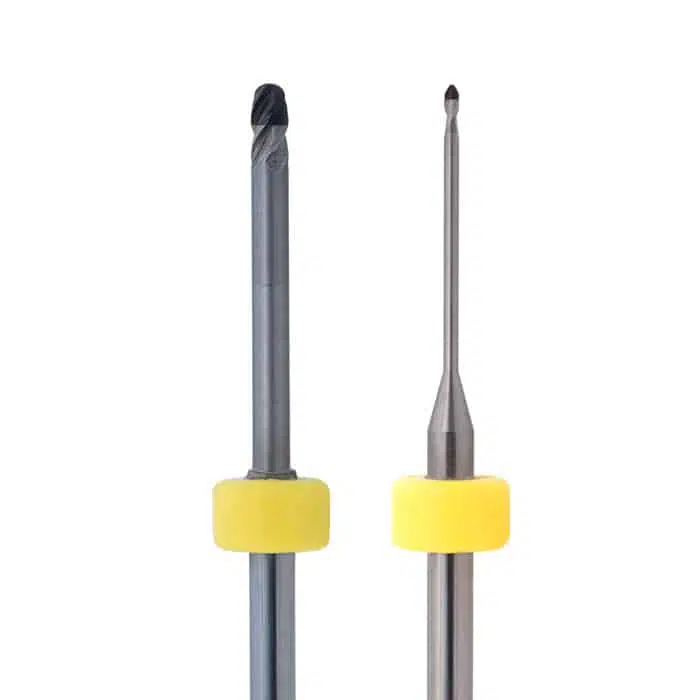
Solid HSS End Mills
Durable and precise Solid HSS End Mills designed for efficient metal cutting and smooth surface finishes in a variety of machining applications.
Order NowFor Customization
Product Details
Solid
HSS End Mills – Product Overview
Solid HSS End Mills are cutting tools made from high-speed steel, designed for
milling operations in various materials. They are favored for their durability,
versatility, and cost-effectiveness in machining processes.
Key
Features:
- Material Composition: Typically made from high-speed steel alloys, such as M2 or M42, which include elements like tungsten, molybdenum, and cobalt to enhance hardness and heat resistance.
- Design Variations: Available in different configurations, including single-end and double-end designs, with various flute counts (e.g., 2-flute, 4-flute) to suit specific cutting requirements.
- Coatings:
Some HSS end mills come with coatings like TiN (Titanium Nitride) to
reduce friction and increase tool life.
- Applications: Ideal for machining softer materials such as aluminum, brass, and mild steel.
❓ 10 Frequently Asked Questions (FAQs)
- What materials can Solid HSS End Mills cut?
- They are suitable for cutting materials like aluminum, brass, mild steel, and plastics. For harder materials, carbide tools might be more appropriate.
- How do I choose between single-end and double-end HSS
end mills?
- Single-end mills are cost-effective and robust for dedicated tasks. Double-end mills offer extended tool life by allowing users to flip the tool and utilize the unused cutting edge.
- What is the significance of the number of flutes on an
end mill?
- Fewer flutes allow for larger chip loads, suitable for heavier cutting operations. More flutes result in finer finishes and are preferred for detailed work on more rigid materials.
- Can HSS end mills be used for high-speed machining?
- While HSS end mills can withstand higher temperatures than carbide tools, exceeding recommended speeds can lead to premature wear. For high-speed machining, carbide tools are often preferred.
- Are HSS end mills re-sharpenable?
- Yes, one of the advantages of HSS end mills is their amenability to re-sharpening, which extends the tool’s life and reduces overall tool cost.
- What is the typical lifespan of an HSS end mill?
- The lifespan varies based on material hardness,
cutting conditions, and maintenance. Regular re-sharpening can prolong
their usability.
- How should I maintain HSS end mills?
- Regular inspection, proper storage, and timely
re-sharpening are essential for maintaining HSS end mills.
- What coatings are available for HSS end mills?
- Common coatings include TiN (Titanium Nitride), TiCN
(Titanium Carbonitride), and AlTiN (Aluminum Titanium Nitride), which
enhance hardness and reduce wear.
- Can HSS end mills be used for both roughing and
finishing operations?
- Yes, depending on the design and coating, HSS end
mills can be utilized for both roughing and finishing operations.
- Where can I purchase Solid HSS End Mills in India?
- Suppliers like MISUMI India offer a range of HSS end
mills suitable for various applications.
Customer Ratings
5.0/5
Based on 2 reviews
Customization product
I’ve been using this product for several months now, and it stands out as one of the best tools for customization in manufacturing. Whether you're working with metal, plastic, or composites, this tool adapts easily to different workflows and materials. Highly recommended for teams looking for precision, efficiency, and customization all in one.