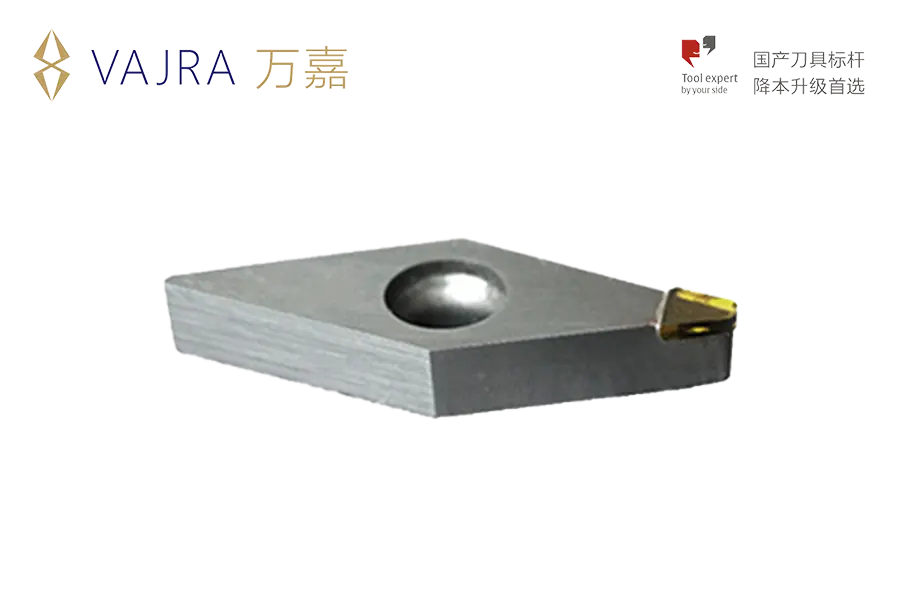
Vajra® Standard inserts
The Vajra® Standard Inserts series is part of the “VAJRA” ultra-precision machining tool portfolio from JD Diamond Tool. According to the manufacturer: • “Vajra® Standard inserts … breakthrough MCD material processing space, development diversified ‘Vajra’ series MCD ultra-precision machining tool series, widely used in precision turning, milling, drilling, and nano-scale high polishing surface machining.” • The term “MCD” here stands for monocrystalline diamond (or synthetic single-crystal diamond) material, which offers very high hardness, excellent wear resistance, low friction, high thermal conductivity and low thermal expansion — important for ultra‐precision machining of non-ferrous or difficult-to-machine materials. • The Vajra® Standard Inserts appear to be a “standard blade/ECO” component category under the product mix. Thus, the series is positioned for high-precision finishing, ultra-fine geometry, and minimal variation in critical surfaces, likely in non-ferrous, composite or high-end manufacturing environments. In simpler terms: these inserts are cutting-tool inserts made from (or tipped with) ultra-hard diamond material (MCD) designed for very precise turning, milling or drilling operations where surface finish, tool life and dimensional accuracy are premium.
Order NowFor Customization
Product Details
Key Features
Here are the standout features of the Vajra® Standard Inserts series:
1. Ultra-hard material (MCD / monocrystalline diamond) – The use of synthetic or true single-crystal diamond gives very high hardness and wear resistance, making them suitable for demanding finishing operations.
2. Ultra‐precision geometry – The series is described as “ultra-precision machining tool series … nanoscale high polishing surface machining.” This implies very tight tolerances, minimal run-out or variation.
3. Wide usage across turning, milling, drilling – Versatility: not limited to one operation. The description mentions turning, milling, drilling.
4. High surface finish capability – Because of the diamond tool material and ultra‐precision focus, the inserts are optimized for operations demanding very fine surface finishes and minimal secondary polishing.
5. Long tool life / reduced wear – Diamond tools typically out-last conventional carbide or coated inserts in abrasive or difficult materials. The material characteristics (high thermal conductivity, low expansion) support stable cutting edges.
6. Minimal manual finishing required – With ultra-precision inserts, the downstream manual polishing or re-working can often be reduced.
7. Customizable / specialized options – The manufacturer notes “then we can make deep development and customize cutting tools according to customer's processing requirements.”
8. Optimized for non-ferrous / composite / high-precision materials – Because diamond has affinity issues with ferrous materials at high temperatures, these inserts are likely targeted for aluminium alloys, composites, maybe non-ferrous metals. The Vajra series overall is described in that context.
9. Sharper edge and stable geometry – The insert geometry is optimized to maintain sharpness and dimensional accuracy over time, critical in precision finishing.
10. Cost-efficient in high precision contexts – While the upfront cost is likely higher, the advantages in reduced rework, less downtime, long tool life make them cost-effective for premium applications.
Customer Ratings
5.0/5
Based on 2 reviews
Customization product
I’ve been using this product for several months now, and it stands out as one of the best tools for customization in manufacturing. Whether you're working with metal, plastic, or composites, this tool adapts easily to different workflows and materials. Highly recommended for teams looking for precision, efficiency, and customization all in one.
Frequently Asked Questions
Q1: What materials are these inserts best suited for?
A1: The Vajra® Standard Inserts, being MCD/diamond-based, are
ideally suited for non-ferrous metals (such as aluminium, copper, brass),
composites (CFRP, GFRP), metal matrix composites, and high-precision finishing
operations. According to the manufacturer the Vajra series targets “nano-scale
high polishing surface machining” etc. They are less suitable for heavy cutting
of ferrous steels or stainless steels unless specially adapted
(diamond-on-ferrous is more challenging due to chemical affinity).
Q2: What distinguishes the “Standard Inserts” from other Vajra tools
(e.g., turning, chamfer, drill variants)?
A2: The “Standard Inserts” appear to form a general or
baseline part of the Vajra series, offering ultra-precision finishing for
turning/milling/drilling. Other variants (e.g., Vajra® Chamfer tools, Vajra®
Drill tools) are purpose-built for specific operations. For example, the
standard inserts may cover conventional finishing tasks whereas the drill
variant is for ultra‐precision drilling.
Q3: What advantages do these inserts offer compared to conventional
carbide or coated inserts?
A3: Key advantages are: much higher wear resistance,
maintaining sharper cutting edges for longer; better surface finish and
dimensional accuracy; less tool change downtime; potential elimination of
downstream finishing/polishing steps; improved process stability. The diamond
material’s physical properties (high hardness, thermal conductivity, low expansion)
contribute to this.
Q4: Are there any limitations or things to watch out for?
A4: Yes — Since MCD/diamond materials are brittle and have
certain chemical limitations (especially when machining ferrous materials or
operating at high temperatures), you’ll want to ensure: the tool is used within
its recommended material domain, machine setup is rigid (to avoid
chipping/breakage), workholding is stable, and cutting parameters (speed, feed,
depth) are appropriate for diamond inserts. Also, upfront cost may be higher
compared to standard inserts.
Q5: How should I select cutting parameters when using these inserts?
A5: While specific data may depend on the exact insert
grade/geometry and workpiece material, general advice: use moderate to high
spindle speeds (given good heat dissipation of diamond), minimal to moderate
depth of cut (especially for finishing), ensure machine/run-out rigidity is
optimal, avoid excessive vibration or deflection, use proper coolant or
lubrication as recommended by manufacturer. Also ensure chip evacuation is
effective. For detailed values, refer to the manufacturer’s insert-specific
datasheet or technical support.
Q6: What finish quality or tolerance improvements can I expect?
A6: Because these are ultra-precision inserts, you can expect
improved surface finish (lower Ra values), better dimensional accuracy, fewer
tool-wear induced deviations, and more stable process across the production
run. The manufacturer emphasizes “nanoscale high polishing surface machining”
for the Vajra series.
Q7: Can these inserts be re-conditioned or reused?
A7: The manufacturer mentions customization and deep
development, but for the Standard Inserts they don’t explicitly say
“re-grindable”. However, in the broader tool lines (e.g., PCD full-face inserts)
they note regrinding or retipping possibility. You should check with JD Diamond
Tool whether the particular Vajra® Standard Insert grade supports
re-conditioning.
Q8: What key data or spec sheet items should I ask from the
supplier?
A8: You should request:
· The specific insert geometry (shape, nose radius, clearance angles)
· Material/substrate grade (MCD grade, diamond type, substrate)
· Applicable workpiece materials or material groups
· Recommended cutting parameters (speed, feed, DOC) for your material
· Tool life expectations or data (for your material)
· Tolerances of the finished part when using the insert (e.g., flank accuracy, surface finish)
· Whether re-conditioning/refurbishing is available
· Any machine requirement (e.g., run-out tolerance, holding rigidity)
· Insert mounting/clamping details (insert seat, toolholder compatibility)
· Availability of spare inserts or consumables.
Q9: What are typical application scenarios where these inserts
really pay off?
A9: Scenarios include:
· Finishing aluminium alloy engine blocks where high finishing accuracy and minimal polishing are valuable.
· Machining of metal-matrix composite (MMC) materials, which are highly abrasive to conventional tools.
· Machining of high-precision mould or die components requiring mirror surfaces.
· Aerospace components made of lightweight alloy or composite materials where repeatability/high surface integrity matters.
· High-volume production runs where tool change downtime and variation matter.
Q10: How do I know if I should upgrade from my current inserts to
the Vajra® Standard Inserts?
A10: Consider upgrading if you observe:
· Frequent tool wear or short tool life with your current inserts (especially in abrasive materials)
· Surface finish, dimensional accuracy or repeatability issues in your finishing operations
· High cost/time in downstream polishing or re-working of surfaces
· High scrap or rework due to tool-wear induced variation
· Need for improved productivity, longer runs between tool changes, or tighter tolerances. In such cases the Vajra® series may offer sufficient benefit to justify the higher initial cost.